

why walking will save your life
on the magic that walking brings and all the ways it enriches our lives

I’ve walked myself out of every bad thing that’s ever happened to me. Heartbreak, grief, family illnesses, stress. I’ve walked with all my maladies for so long until they separated from my shoes and blended with the pavement underneath. Those victory days are well documented in the health app on my phone. September 20th, 2022 – 28,549 steps – the month of my break up.
Walking is the most universal remedy I know and here’s why I think walking more should become your priority:

How walking affects your body
“Walking is man’s best medicine.” – Hippocrates, ~400 BCE
The concept of Blue Zones was originally developed by a couple of researchers who used a blue marker to circle a region of extreme longevity in Sardinia on a map. National Geographic later expanded on this and identified five global hotspots with the highest concentration of centenarians with these being Sardinia, Okinawa, Nicoya, Ikaria, and Loma Linda. The 5 regions share almost no diet specifics, but they do all share one thing and that’s natural movement. In the Blue Zones, walking isn’t an “exercise” that people schedule into their day, instead it’s an unavoidable, ever-present part of their environment.
The British Journal of Sports Medicine found that the least active 25% of the population could add up to 10.9 years to their lives by walking for 111 minutes a day. For that group, every extra hour of walking may add about 376 minutes or 6.3 hours to their lives.* Eleven years is a lot, even if you are not trying to make it to three digits.
While on the topic of aging, there is a measure called epigenetic age, which tracks the physiological wear on your cells against your chronological age. A 2024 Mendelian randomisation study found that faster walking pace was linked to slower epigenetic aging, while walking duration alone showed no clear effect. In other words, walking may help you live longer, and walking faster may help you age more slowly on the inside.
The Mediterranean countries have this concept called the passeggiata: an evening stroll taken slowly, often after dinner, with no destination in particular. No one thinks of it as cardio and very few are tracking it on their apple watch as exercise. But research has found that even a few minutes of light walking after a meal can reduce blood sugar by about 10%.*
As for matters of the heart, walking for 30 minutes a day, five days a week, has been linked to a 19% lower risk of coronary heart disease.* Interestingly enough, one large U.S. study found that women may derive even greater cardiovascular benefit than men from the same amount of walking.*
The link between walking and cancer survival is one of the most striking in the literature. Women who walked three to five hours a week after a breast cancer diagnosis showed roughly 25 to 50% lower mortality compared to inactive women, with the strongest effects in hormone-responsive tumors.* Similar protective associations have been documented in colon cancer survivors.* The likely mechanism is mechanical: contracting muscles release signaling proteins called myokines into the bloodstream, and some appear to slow tumor growth and help the immune system clear malignant cells.
As for avoiding further sickness, moderate daily walking has been shown to boost natural killer cell activity and reduce upper respiratory infection rates by 40-50%.* And indeed, a study tracking over 1,000 adults during flu season found that those who walked at a moderate pace for 30 to 45 minutes a day had 43% fewer sick days and substantially milder upper respiratory tract symptoms when they did get sick*.
Walking is widely recognised by biomechanics and physiological experts as the most natural human movement for a reason. We keep inventing new forms of exercise, when the most effective one was the one we started practicing shortly after birth.
How walking affects your mental wellbeing
“Above all, do not lose your desire to walk. Every day I walk myself into a state of well-being and walk away from every illness… I have walked myself into my best thoughts.”
– Kierkegaard in a letter to his niece Jette (1847)
The mental effects of walking are just as striking as the physical ones. A landmark meta-analysis of 218 studies with over 14,000 participants found that walking and jogging produced reductions in depressive symptoms comparable to, and in some cases greater than, antidepressants or psychotherapy alone.*
Another meta-analysis found that even an additional 1,000 steps per day was associated with roughly a 9% lower risk of depression, with most of the psychological benefits plateauing around 7,500 daily steps.*
Indeed the 10,000 steps per day mantra we’ve all been indoctrinated with has (surprise, surprise) no scientific base. The myth was invented by Japanese pedometer company Yamasa Clock in 1965 for their Manpo-kei device (literally the “10,000 step meter”) to capitalise on the Tokyo Olympics fitness hype. Why 10K? Because the kanji for 10,000 (万) supposedly resembles a walking person.
Stanford research also shows that a 90-min walk in nature reduces rumination and activity in the subgenual prefrontal cortex (an area linked to depressive thinking).* So while any walk is a good walk, a walk in the forest or around a lake every once in a while essentially works like noise-cancelling headphones for the mind.

Another widely repeated piece of advice comes from Stanford neurobiologist Andrew Huberman, who recommends getting outside for 10-20 minutes of morning light soon after waking. The reason is simple: morning light hitting the retina helps anchor your circadian rhythm, suppress melatonin at the right time, regulate cortisol, and improve mood, sleep, and dopamine regulation throughout the day.* You can get it by sitting on a balcony for 15 minutes, but Huberman recommends pairing it with a walk. I like to think of it less as “optimising” the morning and more as setting the tone my nervous system follows for the rest of the day.
What’s also interesting is that the act of moving forward through space appears to change how the brain processes stress and threat. As you walk, the visual world continuously moves past your eyes in a pattern neuroscientists call optic flow. Research suggests this self-generated visual motion can help quiet activity in the amygdala, the brain region heavily involved in fear and anxiety processing.*
I truly believe that in those moments when being inside your own head feels a bit like being waterboarded – whether by stress, overthinking, or negative thoughts – simply putting your shoes on and walking for at least 30 minutes can interrupt the spiral and, often, stop it altogether. I’ve walked myself out of so much. And even when a family member fell into the depths of the worst depression I’ve ever witnessed, the times we walked together were some of the only bearable moments in what became some of the hardest weeks of our lives.
How walking regenerates your brain
The relationship between walking and the brain becomes even more striking with age. A large 2022 study found that around 9,800 daily steps was associated with roughly a 50% lower risk of dementia, with measurable protective effects beginning at just 3,800 steps a day.*
Even more remarkable is what walking appears to do to the physical structure of the brain itself. One study found that one year of moderate walking, around 40 minutes three times a week, increased hippocampal volume in older adults by roughly 2%, effectively reversing one to two years of age-related shrinkage. The hippocampus is heavily involved in memory and learning and is one of the first regions affected by Alzheimer’s disease. Researchers linked the effect partly to increased levels of Brain-Derived Neurotrophic Factor (BDNF), the protein involved in neuron growth and neural resilience.* In other words, walking was not just slowing cognitive decline, but quite literally helping the brain rebuild itself.
While I don’t have evidence for this, it feels plausible that many of walking’s cognitive benefits matter even more in an age of chronic doomscrolling and fractured attention spans, making them relevant not just to aging populations, but to people in their 20s and 30s too.
How walking becomes your creative muse

Walking and ideas go hand in hand, which is why we often come home with a new perspective or solution for a problem we’ve been trying to find for weeks. As Elle points out: Almost every one of Jane Austen’s characters reaches an epiphany while taking a walk.
One of the more interesting ideas in psychology and neuroscience is that thought is not as detached from the body as we like to imagine. The theory of embodied cognition argues that the mind does not operate separately from physical experience, but through it. Open-ended bodily movement like walking, wandering, pacing, or moving through unfamiliar environments tends to correlate with more expansive, associative thinking. In contrast, static environments and closed bodily states often produce more rigid, repetitive patterns of thought. It’s not just the body that carries the brain from place to place, it’s also the places we pass through that shape the direction of thought.
Indeed, a 2014 Stanford study found that walking roughly doubled the number of creative ideas people generated compared to sitting, with the effect persisting even after they sat back down.*
Research on the brain’s Default Mode Network offers another explanation for why walking can feel strangely clarifying. The network is tied to autobiographical reflection, imagination, memory, and the linking together of seemingly unrelated thoughts. Walking creates a kind of cognitive middle ground: the mind is engaged, but not trapped in intense concentration leaving enough mental space for thoughts to rearrange themselves in the background.*
Executive Control Network research adds another layer to this. The network is responsible for logic, planning, decision-making, and goal-directed thinking. What makes walking so cognitively powerful is that it appears to create a productive balance between the brain’s reflective, associative mode and its analytical one.* In other words, walking helps you generate ideas while simultaneously evaluating them, which may explain why so many people don’t just think more creatively while walking, but also think more clearly.
Movement also increases the release of the BDNF, the aforementioned protein often described as “fertilizer for the brain.” BDNF supports the survival of existing neurons while encouraging the growth of new ones and strengthening the connections between them. In practical terms, it helps create a brain that is more adaptable, resilient, and capable of learning.*
Walking actually alters the brain’s chemistry by increasing levels of dopamine and norepinephrine. These chemicals improve your mood, sharpen your focus, and make you more motivated to solve difficult tasks. Walking also increases blood flow and oxygen to the brain, naturally boosting alertness and executive function without the jitters of a 4th coffee of the day.*
All of the above might be part of the reason why some of the world’s most successful founders prefer to take their meetings on foot. Steve Jobs was known for this and many others have since then followed in his footsteps.
But this relationship between movement and thought long predates Silicon Valley productivity culture. Friedrich Nietzsche reportedly walked between six and eight hours a day during some of his most productive years in Sils-Maria, insisting that “all truly great thoughts are conceived by walking” and that one should “never trust a thought that occurs indoors.”

Julia Cameron, the author of The Artist’s Way, later published a follow-up book titled Walking in This World, where she explores walking not just as exercise, but as a creative and psychological practice. For Cameron, walking becomes a way of unblocking thought, restoring attention, and creating the mental spaciousness needed for ideas to emerge again.
I generally separate my walks into two types: those with and without headphones. I leave my headphones at home when my goal is to reflect on something or bump into new ideas along the way. I put them on when my goal is pure escape and a real page break from the day I just had.
“The magic of the street is the mingling of the errand and the epiphany.”
― Rebecca Solnit, Wanderlust: A History of Walking
How walking creates perspective

Walking is an effective tool not only when you’re in a creative rut or searching for a solution to a work problem, but also when you simply need space to reflect on the inner and outer layers of your life.
Elle has written a great article about this called the case for a long walk, which I’ve taken the liberty to quote below and highly recommend as follow up reading:
There is something about the act of walking that quiets down all the extraneous murmurs in your brain, and everything suddenly morphs into clear cut clarity. It’s not a miracle cure, but it sometimes is the only thing that works and allows you to see your life at a distance. You can’t see the full panoramic view of a meandering river if you are sitting closely on its banks.
I swear by this ability walking has to let you see your life from a distance. The moment you step out into a street, a forest, or onto a beach, your problems no longer sit directly on top of you. You leave them a few steps behind, and that slight separation, paired with the perspective that movement creates, is often what allows insight to finally appear.
How walking improves our relationships
Steve Jobs famously preferred walking meetings. But movement seems to change not only how we think, but also how we relate to one another. Without laptops open and with only the road ahead of us, we become more anchored to the present conversation itself, which seems to increase openness, engagement, and the quality of listening.*
Not only can walking make cooperation easier, it can also make conflict resolution smoother. Research suggests walking changes conflict dynamics in two important ways. First, the side-by-side posture feels far less confrontational than sitting face-to-face across a table, lowering psychological resistance during difficult conversations. Second, the act of physically moving forward appears to influence thought itself. The brain often maps physical movement onto emotional processing, meaning that “moving forward” through space can subtly help people move forward psychologically too.*
This is partly the reason why many therapists often utilise “walk-and-talk” interventions. The combination of dynamic environments and the lack of intense, continuous eye contact makes it easier for us to voice deep-seated vulnerabilities or sensitive desires that we might otherwise suppress in a static, face-to-face setting.*
I love walking with my loved ones. I love when you suddenly realise neither of you has been paying attention to the route because the conversation has quietly taken precedence over the path itself. One of the most open conversations I’ve ever had with my dad happened on our weekend trip to Paris. The streets themselves have mostly blurred together in my memory, but the conversation remains almost perfectly intact.
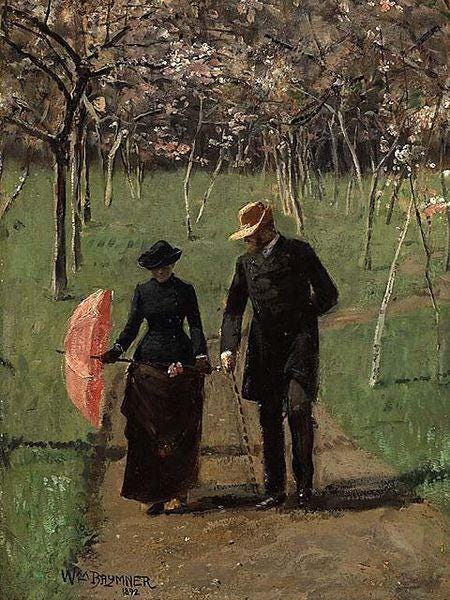
Solvitur ambulando
Solvitur ambulando is a famous Latin phrase that translates to “it is solved by walking.” It’s attributed to Diogenes the Cynic and I’ve found it to be true too many times to count. There is something about the simple act of putting one foot in front of the other that restores proportion to things. Problems that felt suffocating indoors become strangely solvable, thoughts loosen their grip and the inner skies clear. I hope this essay convinces you to take an extra few steps here and there, whether a few hundred or a couple thousand. It’s difficult to think of another human activity with such a profound positive impact which you neither need to buy nor learn how to do. And as Gros writes in A Philosophy of Walking, when it comes to walking “there is only one sort of performance that counts: the brilliance of the sky, the splendour of the landscape.”
*A comprehensive list of references can be found here.
What struck me most is how all the data keeps circling back to something simple. Movement as a way of living, not a workout you schedule. The longevity yes, but the real benefit is how it sharpens the mind and steadies the spirit.
i can genuinely say this is absolutely true. as someone who has started walking consistently over the past few months, i didn’t realize how much of a difference it would make until i experienced it myself. thank you for sharing such a thoughtful write up♥️♥️