

the chemistry between us
the science, psychology and mystery of instant connection

There are thousands of Reddit threads and comments discussing actors that have “insane chemistry”. We watch people we’ve never met, who pretend for a living, interact on screen and somehow form opinions carved in marble about what exists between them. We go on dates with people who are perfect on paper and end up leaving exhausted and unmoved by the interaction. We listen to our friends try to explain why they like a particular person, using slippery words like “spark”, “click” or the most abstract of all, “energy”.
I’ve always found this astonishing. I’m fascinated by phenomena that are this elusive and intangible, yet so pervasive and central to our experience of living. It’s very much why I write. The kind of chemistry we are talking about is not even the word’s primary definition, yet it often becomes the seed of the most important relationships in our lives. I suspect it belongs to the same strange category as gut feelings, sensing that someone is watching you or thinking of a person moments before they call. We understand them, but not with the clean satisfaction with which we understand electricity, even if chemistry often feels a little like electricity itself. Still, we can try to name the unnameable, to take this elusive substance and give it some kind of shape.
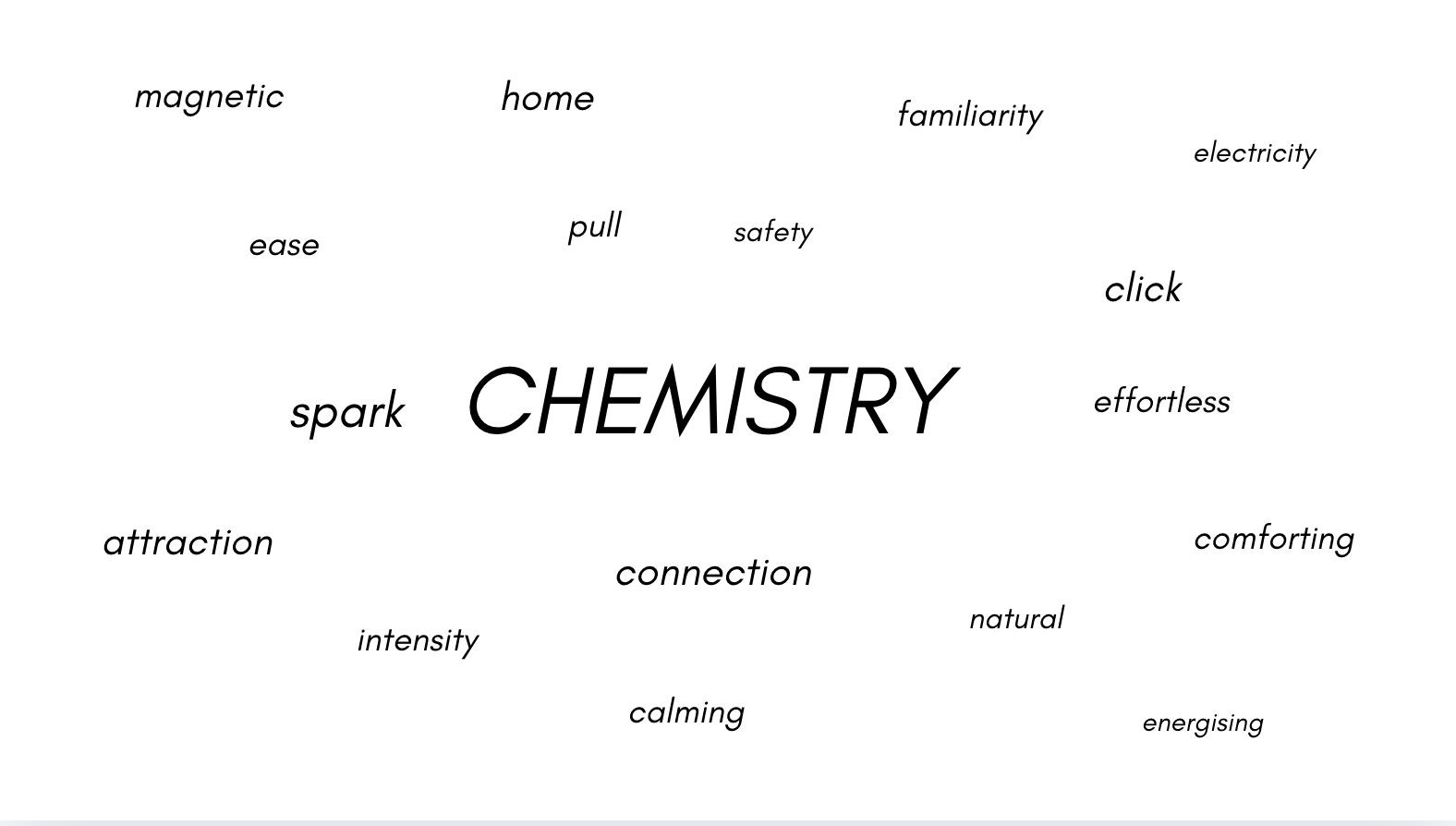
One thing I know for sure is that chemistry, however abstract, is not confined to romantic relationships. I have felt it in friendship as well as in love: a kind of magnetism that made certain people seem brighter than everyone around them, like someone in a red T-shirt moving through a crowd dressed in grey. Alive, expansive, vivid and rare.
When you meet a person you have strong chemistry with, there’s a certain pull that’s nothing if not primal. Like muscle memory for something you don’t remember learning, as if your body is answering to cues your mind hasn’t yet processed. You might bump into them on the street, exchange nothing remarkable and never touch, yet walk away feeling magnetised and electrified. Without your permission, your inner compass recalibrates and begins pointing towards them without you understanding why or sometimes even being aware of it. Somehow, the collision of a few atoms is enough to leave you spellbound.

Chemistry is not the same feeling as infatuation, desire, sexual tension or love, even if it often overlaps with all of them. It can occasionally be one-sided, but in its most potent form it tends to be reciprocal.
As research for this essay, I spent more time trawling Reddit threads than doing almost anything else. It was fascinating to watch people reach for language around this extraordinary phenomenon. They used phrases like “operating on the same wavelength” and “being in sync” and “in tune” with one another. There was one that compared it to two synchronised clocks and one that called it a “gravitational pull toward each other”. Another that said it was like “energy you don’t question, like knowing the sky is blue”. The word simpatico, which English has technically adapted but barely uses, appeared again and again. Colourful images, words and metaphors, all trying to pin down the same elusive experience.



So, as intangible as chemistry may be, it is undeniably real. The language we use to describe it varies, but we seem to be pointing towards the same thing, which is how large swathes of the internet can agree that Ginny and Harry have none while Hermione and Malfoy somehow have plenty. But what are the conditions necessary for it to arise though and are there any really?

To begin with, smell seems to play some role in why we feel drawn to certain people. There is a famous study, taught in most psychology 101 courses, in which women were asked to smell T-shirts that men had worn for two nights. The researchers found that women who were not taking oral contraceptives generally preferred the scent of men whose major histocompatibility complex, or MHC (a group of genes central to immune function), differed from their own. The proposed evolutionary logic was neat: choosing a genetically dissimilar partner would produce offspring with more varied immune defences. Women taking the pill, however, showed the opposite pattern.* But the actual picture is considerably messier. A comprehensive 2020 meta-analysis found no significant overall relationship between MHC dissimilarity and odour preference or partner choice.* So smell may play a part in creating chemistry, but even if we do prefer the scent of certain potential partners, that preference may be less evolutionarily hard-wired than the original findings made it seem.
Another popular finding suggests that we prefer partners who look like us. Studies have found that people sometimes favour subtly self-resembling versions of a partner’s face, while couples tend to resemble each other more than random pairs do.* This fits a wider pattern known as assortative mating: people disproportionately form relationships with those who resemble them not only physically, but also in characteristics such as education, values or social background.* Yet resemblance does not produce desire in a straightforward way. Self-resembling faces have sometimes been judged more trustworthy but less attractive as short-term sexual partners, while other studies have produced mixed results.* What resemblance may offer, then, is not chemistry itself but one of its possible foundations: a faint sense of familiarity and kinship that makes a stranger feel less strange.
Familiarity, it seems, lies at the heart of the mystery of chemistry. In some Slavic languages, there is an expression usually reserved for people who have become almost like family, it’s saying that someone is “ours”. It carries a warm, powerful connotation, holding within it years of closeness. I think there is an overlap between that feeling and the way we experience people with whom we have chemistry. Sometimes, it feels as though we have known them our whole lives. They are ours from the very start.
Where that familiarity comes from varies, and sometimes its origins are less benign. Each person you meet arrives carrying residue from previous relationships, fantasies, fears and unmet needs. We tend to gravitate towards people who remind us of dynamics that feel safe (even if that’s not always the case).* A parental figure, a childhood friendship, an ex-partner’s way of speaking. Research on transference shows that when a new person resembles a significant figure from our past, representations associated with that earlier relationship can become activated.* The mystical feeling of “I have known you forever” can therefore carry elements of: you allow me to live out an unfinished relationship, your temperament resembles people I already understand, you remind me of a person I once needed. Familiarity comforts the brain, creating an often false sense of returning home and sometimes leading us to seek out the same person “in different fonts.” But the sense of coming home isn’t always a trap and sometimes that familiarity can be nothing but a beautiful, pure thing.
Ease is another crucial piece of the puzzle. In that sense, it’s a bit like good friendship. When you look back on the beginnings of one, you can hardly ever pinpoint the moment you decided that you’d become friends with someone. The best friendships feel easy and effortless, like stepping into a boat that carries you downstream without either person having to paddle. People we have chemistry with tend to feel that way too.
I found chemical equations deeply uninteresting in high school, and I suspect they felt much the same about me. We have not crossed paths since. But I do remember that it is not enough for certain substances simply to be present. Instead, the outcome depends on what else is there, in what proportions and how the substances react with one another.
This has led me to think that ease and familiarity must exist in the right doses. Pure familiarity can feel safe but flat. Pure novelty can feel exciting but strange. Chemistry seems to live somewhere between the two, where a person feels familiar enough to trust and strange enough to remain intriguing. They ground and electrify us at once. That duality seems central to the experience: meeting someone with whom you have chemistry can feel like eating a hearty meal that leaves you full for hours while simultaneously wondering how soon you can have it again. In the right proportions, the contradiction becomes the reaction.
Another striking parallel comes from research on physiological synchrony. In one blind-date study, participants wore eye-tracking glasses while their heart rate and skin conductance were monitored. Visible signals such as smiling, laughter or eye contact did not predict attraction. Instead, people reported greater attraction when their heart rates and skin conductance rose and fell in sync.* Chemistry, then, may register not only in what two people consciously do, but in whether their bodies fall into the same rhythm so many people describe online.
Interestingly enough, research on ideal preferences suggests that what people say they want in a partner doesn’t faithfully map onto who they end up desiring in real life. They have some predictive power, but we tend to overestimate their significance. Perhaps even more strikingly, a machine-learning study using more than 100 measures of participants’ traits and preferences failed to predict which specific people would desire one another, suggesting that compatibility is remarkably difficult to foresee before two people meet.* Chemistry is likely the unseen hand influencing the result while we stay busy evaluating rational factors.

Chemistry usually places the emphasis on the other person and the feelings they stir in the pits of our stomachs. But sometimes there’s a third person present in the room and that person is the version of ourselves that appears in their company. Research on self-expansion suggests that relationships feel rewarding when they enlarge our sense of possibility and expand the boundaries of who we are.* A person might unlock the door to a more playful version of ourselves or a bolder and more curious one. Though it is difficult to determine whether this expanded sense of self helps create chemistry or emerges because the chemistry is already there.


Finally, when it comes to whether chemistry can be cultivated, I’m inclined to believe that it must first exist in some form. A faint flame can be fed, strengthened and sustained, but no amount of tending can create one where nothing ever caught. A fire can also be extinguished, but it leaves behind evidence that something once burned there.
Chemistry cannot be forced into existence by rational factors, not even those we consider especially valuable or rare, such as physical attraction or exceptional conversation. Those qualities may provide the right conditions, but they can guarantee neither the reaction nor that the feeling, however powerful, is one we should trust.
The reaction seems to depend on the right balance of opposites: familiarity and novelty, ease and intensity. Similarity also plays a role, whether someone resembles us or evokes earlier forms of love and friendship we are unconsciously drawn to repeat. The way their presence awakens parts of us that otherwise remain dormant may be equally important. But even after accounting for those elements, something inexplicable still remains.
The word chemistry emerged around the beginning of the seventeenth century from alchemy, a practice that brought together material experimentation, medicine, philosophy, astrology and mysticism. Perhaps the chemistry between us follows the same lineage: partly biological, partly psychological, partly philosophical, and never entirely stripped of mystery.
*A comprehensive list of references can be found here.
this was such an interesting read!!!
"relationships feel rewarding when they enlarge our sense of possibility and expand the boundaries of who we are.* A person might unlock the door to a more playful version of ourselves or a bolder and more curious one. Though it is difficult to determine whether this expanded sense of self helps create chemistry or emerges because the chemistry is already there."
-I especially loved these lines because they capture what I am looking for in a relationship: expansion, enrichment and variety. Someone who is similar to me in her innermost psychic nature, yet entirely different in her experiences and or the way she engages with the world.
I should mention that the studies did not interest me personally, and I skipped over them.
What I enjoyed was being exposed to your own thoughts. I also appreciate the fact that you invested so much time in reading Reddit threads, which in my eyes makes this part of your exploration more trustworthy than any study currently available. After all, we are speaking about something so profoundly human, abstract, and spiritual that as you expressed so well other forms of description cannot truly define it through measurable means.